16S/18S/12S
This is executable step-by-step pipeline for 16S/18S/12S amplicon data from Illumina sequencing machine. The bioinformatic workflow results in amplicon sequence variants (ASVs) and well as operational taxonomic units (OTUs).
Note
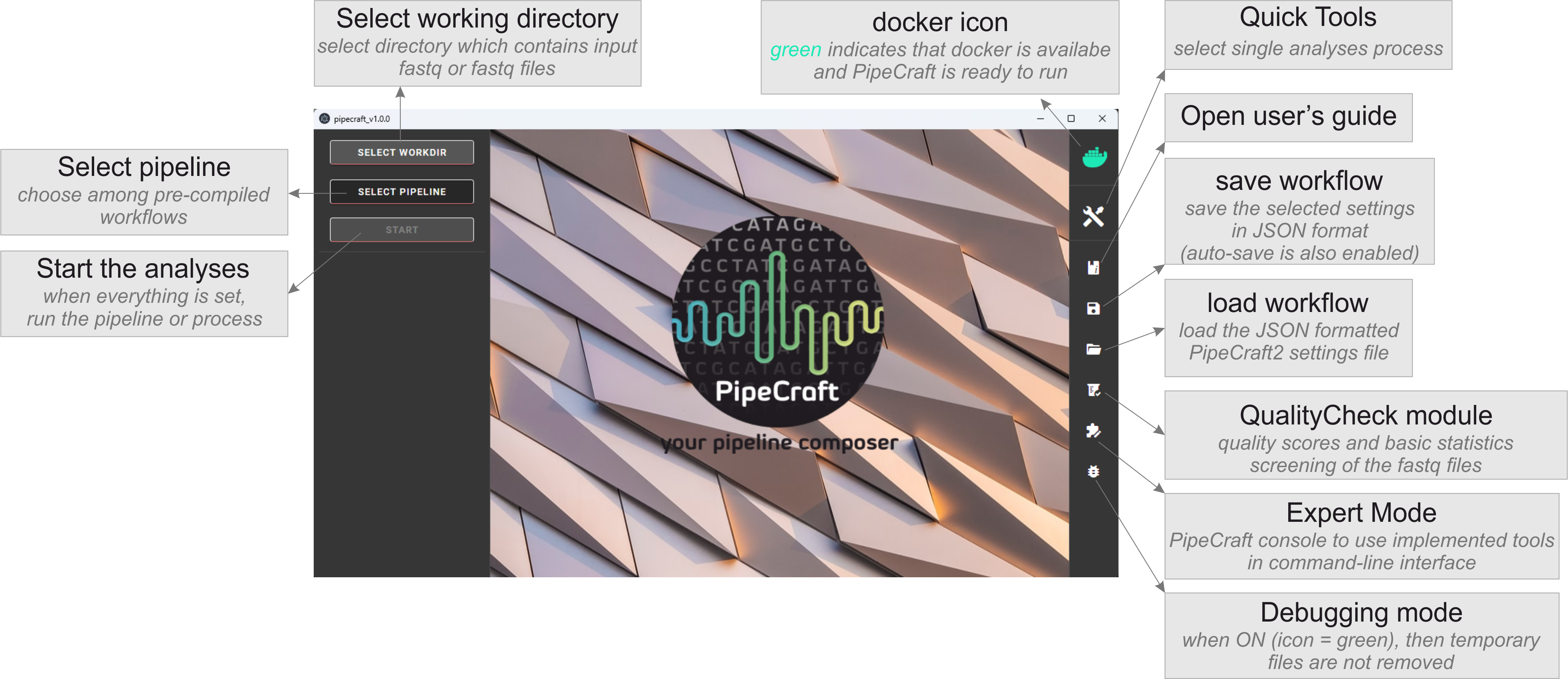
The full bioinformatics workflow can be automatically run through PipeCraft2, a software package which represents a graphical user interface wrapper for all the bioinformatic steps below. See the example workflow for 16S.
Citation of the pipeline
When using this pipeline, please cite as: Anslan, S, Bahram, M, Hiiesalu, I, Tedersoo, L. PipeCraft: Flexible open-source toolkit for bioinformatics analysis of custom high-throughput amplicon sequencing data. Mol Ecol Resour. 2017; 17: e234-e240. https://doi.org/10.1111/1755-0998.12692
Also, please cite the original resources of the wrapped software.
Dependencies
Process |
Software |
Version |
|---|---|---|
cutadapt |
4.9 |
|
DADA2 |
1.30 |
|
DADA2 |
1.30 |
|
DADA2 |
1.30 |
|
DADA2 |
1.30 |
|
UNCROSS2 |
||
DADA2 |
1.30 |
|
RDP |
in DADA2 v1.30 |
|
vsearch |
2.28.1 |
|
BLAST |
2.12.0+ |
|
LULU |
0.1.0+ |
*only applicable when there are multiple sequencing runs per study.
Note
All the dependencies/software of the pipeline are available on a Docker image.
docker pull pipecraft/bioscanflow:2
# run docker
 # specify the files location with -v flag  ($PWD = the current working directory)
docker run -i --tty -v $PWD/:/Files pipecraft/bioscanflow:2

# inside the container, the files are accessible in the /Files dir
cd Files

# checking if cutadapt is available
cutadapt -h

# ready to run the pipe as below ...
 ## make sure that via the shared folder (-v) path you have access also to the reference databases.
Data structure
Multiple sequencing runs
Important
When aiming to combine samples from multiple sequencing runs, then follow the below directory structure
Directory structure:
Note
Fastq files with the same name will be considered as the same sample and will be merged in the “Merge sequencing runs” step.
Single sequencing run
Remove primers
Note
Here, assuming that all sequences are in 5’-3’ orientation! (3’-5’ orient sequences will be discarded with this workflow)
Important
Below, the script is specifying the primers for the 16S data analyses. For 18S and 12S, just replace the primer strings and run the script.
 1 #!/bin/bash
 2 ## workflow to remove primers via cutadapt
 3
 4 # My working folder = /multiRunDir (see dir structure above)
 5
 6 # specify the identifier string for the R1 files
 7 read_R1="_R1"
 8
 9 # specify 16S primers
10 fwd_primer=$"GTGYCAGCMGCCGCGGTAA"    #this is primer 515F for 16S
11 rev_primer=$"GGCCGYCAATTYMTTTRAGTTT" #this is primer 926R for 16S
12
13 # specify 12S primers
14 #fwd_primer=$"GTGCCAGCNRCCGCGGTYANAC"  #this is primer V16S-U-fw
15 #rev_primer=$"ATAGTRGGGTATCTAATCCYAGT" #this is primer V16S-U-rw
16
17 # specify 18S primers
18 #fwd_primer=$"CCAGCASCYGCGGTAATTCC" #this is primer TAReuk454FWD1
19 #rev_primer=$"ACTTTCGTTCTTGATYRA"   #this is primer TAReukREV3
20
21 # edit primer trimming settings
22 maximum_error_rate="2" # Maximum error rate in primer string search;
23                         # if set as 1, then allow 1 mismatch;
24                         # if set as 0.1, then allow mismatch in 10% of the bases,
25                         # i.e. if a primer is 20 bp then allowing 2 mismatches.
26 overlap="19"           # The minimum overlap length. Keep it nearly as high
27                         # as the primer length to avoid short random matches.
28 pair_filter="any"      # Option 'any' discards a read pair if primers are not found in
29                         # either of the read pairs (R1 and R2).
30                         # Option 'both' keeps the read pair if a primer is found in
31                         # at least one of the read pairs.
32
33 # get directory names if working with multiple sequencing runs
34 DIRS=$(ls -d *) # -> sequencing_set01 sequencing_set02 sequencing_set03
35
36 for sequencing_run in $DIRS; do
37     printf "\nWorking with $sequencing_run \n"
38     cd $sequencing_run
39     #-#-#-#-#-#-#-#-#-#-#-#-#-#-#-#-#-#-#-#-#-#-#-#-#-#-#-#-#-#-#
40     # make output dirs
41     mkdir -p primersCut_out
42     mkdir -p primersCut_out/untrimmed
43
44     ### Clip primers with cutadapt
45     for inputR1 in *$read_R1*; do
46         inputR2=$(echo $inputR1 | sed -e 's/R1/R2/')
47         cutadapt --quiet \
48         -e $maximum_error_rate \
49         --minimum-length 32 \
50         --overlap $overlap \
51         --no-indels \
52         --cores=0 \
53         --untrimmed-output primersCut_out/untrimmed/$inputR1 \
54         --untrimmed-paired-output primersCut_out/untrimmed/$inputR2 \
55         --pair-filter=$pair_filter \
56         -g $fwd_primer \
57         -G $rev_primer \
58         -o primersCut_out/$inputR1 \
59         -p primersCut_out/$inputR2 \
60         $inputR1 $inputR2
61     done
62     #-#-#-#-#-#-#-#-#-#-#-#-#-#-#-#-#-#-#-#-#-#-#-#-#-#-#-#-#-#-#
63     cd ..
64 done
Quality filtering
 1 #!/usr/bin/Rscript
 2 ## workflow to perform quality filtering within DADA2
 3
 4 #load dada2 library
 5 library('dada2')
 6
 7 # specify the identifier string for the R1 files
 8 read_R1 = "_R1"
 9
10 # get the identifier string for the R2 files
11 read_R2 = gsub("R1", "R2", read_R1)
12
13 # capturing the directory structure when working with multiple runs
14 wd = getwd() # -> wd is "~/multiRunDir"
15 dirs = list.dirs(recursive = FALSE)
16 for (i in 1:length(dirs)) {
17     if(length(dirs) > 1) {
18         setwd(dirs[i])
19         print(paste0("Working with ", dirs[i]))
20         #-#-#-#-#-#-#-#-#-#-#-#-#-#-#-#-#-#-#-#-#-#-#-#-#-#-#-#-#-#-#
21         # output path
22         path_results = "qualFiltered_out"
23         # input and output file paths
24         R1s = sort(list.files("primersCut_out", pattern = read_R1, full.names = TRUE))
25         R2s = sort(list.files("primersCut_out", pattern = read_R2, full.names = TRUE))
26         #sample names
27         sample_names = sapply(strsplit(basename(R1s), read_R1), `[`, 1)
28
29         # filtered files path
30         filtR1 = file.path(path_results, paste0(sample_names, ".R1.", "fastq.gz"))
31         filtR2 = file.path(path_results, paste0(sample_names, ".R2.", "fastq.gz"))
32         names(filtR1) = sample_names
33         names(filtR2) = sample_names
34
35         #quality filtering
36         qfilt = filterAndTrim(R1s, filtR1, R2s, filtR2,
37                             maxN = 0,            # max number of allowed N bases.
38                             maxEE = c(2, 2),     # max error rate per R1 and R2 read, respectively.
39                             truncQ = 2,          # truncate reads at the first instance of a quality score less than or equal to specified value.
40                             truncLen = c(0, 0),  # truncate reads after specified length for R1 and R2 reads, respectively.
41                             maxLen = 600,        # discard reads longer than specified.
42                             minLen = 100,        # discard reads shorter than specified.
43                             minQ = 2,            # discard reads (after truncation) that contain a quality score below specified value.
44                             matchIDs = TRUE,     # output paired-end reads with matching IDs (for merging).
45                             compress = TRUE,     # gzip the output
46                             multithread = TRUE)  # use multiple threads
47         saveRDS(qfilt, file.path(path_results, "qfilt_reads.rds"))
48
49         # make sequence count report
50         seq_count = cbind(qfilt)
51         colnames(seq_count) = c("input", "qualFiltered")
52         seq_count = as.data.frame(seq_count)
53         seq_count$sample = sample_names
54         # reorder columns
55         seq_count = seq_count[, c("sample", "input", "qualFiltered")]
56         write.csv(seq_count, file.path(path_results, "seq_count_summary.csv"),
57                             row.names = FALSE, quote = FALSE)
58
59         # save filtered R objects for denoising and merging (below)
60         filtR1 = sort(list.files(path_results, pattern = ".R1.fastq.gz", full.names = TRUE))
61         filtR2 = sort(list.files(path_results, pattern = ".R2.fastq.gz", full.names = TRUE))
62         sample_names = sapply(strsplit(basename(filtR1), ".R1.fastq.gz"), `[`, 1)
63         saveRDS(filtR1, file.path(path_results, "filtR1.rds"))
64         saveRDS(filtR2, file.path(path_results, "filtR2.rds"))
65         saveRDS(sample_names, file.path(path_results, "sample_names.rds"))
66         #-#-#-#-#-#-#-#-#-#-#-#-#-#-#-#-#-#-#-#-#-#-#-#-#-#-#-#-#-#-#
67         #set working directory back to "/multiRunDir"
68         setwd(wd)
69     i = i + 1
70     }
71 }
Denoise and merge paired-end reads
 1 #!/usr/bin/Rscript
 2 ## workflow to perform DADA2 denoising and merging
 3
 4 # load dada2 library
 5 library('dada2')
 6
 7 # capturing the directory structure when working with multiple runs
 8 wd = getwd() # -> wd is "~/multiRunDir"
 9 dirs = list.dirs(recursive = FALSE)
10 for (i in 1:length(dirs)) {
11     if(length(dirs) > 1) {
12         setwd(dirs[i])
13         print(paste0("Working with ", dirs[i]))
14         #-#-#-#-#-#-#-#-#-#-#-#-#-#-#-#-#-#-#-#-#-#-#-#-#-#-#-#-#-#-#
15         #load quality filtered files
16         filtR1 = readRDS("qualFiltered_out/filtR1.rds")
17         filtR2 = readRDS("qualFiltered_out/filtR2.rds")
18         qfilt = readRDS("qualFiltered_out/qfilt_reads.rds")
19         sample_names = readRDS("qualFiltered_out/sample_names.rds")
20         cat("\n sample names = ", sample_names, "\n ")
21         names(filtR1) = sample_names
22         names(filtR2) = sample_names
23
24         # create output dir
25         path_results = "denoised_merged"
26         dir.create(path_results, showWarnings = FALSE)
27
28         print("# Denoising ...")
29         # learn the error rates
30         errF = learnErrors(filtR1, multithread = TRUE)
31         errR = learnErrors(filtR2, multithread = TRUE)
32
33         # make error rate figures
34         pdf(file.path(path_results, "Error_rates_R1.pdf"))
35           print( plotErrors(errF) )
36         dev.off()
37         pdf(file.path(path_results, "Error_rates_R2.pdf"))
38           print( plotErrors(errR) )
39         dev.off()
40
41         # Sample inference and merger of paired-end reads
42         mergers = vector("list", length(sample_names))
43         names(mergers) = sample_names
44         for(sample in sample_names) {
45           cat("\n -- Processing:", sample, "\n")
46           derepF = derepFastq(filtR1[[sample]])
47           ddF = dada(derepF, err = errF, multithread = TRUE)
48           derepR = derepFastq(filtR2[[sample]])
49           ddR = dada(derepR, err = errR, multithread = TRUE)
50           merger = mergePairs(ddF, derepF, ddR, derepR)
51           mergers[[sample]] = merger
52         }
53         rm(derepF); rm(derepR)
54         gc()
55         saveRDS(mergers, (file.path(path_results, "mergers.rds")))
56
57         # make sequence table
58         ASV_tab = makeSequenceTable(mergers)
59         #write RDS object
60         saveRDS(ASV_tab, (file.path(path_results, "rawASV_table.rds")))
61
62         # make sequence count report
63         getN = function(x) sum(getUniques(x))
64         #remove 0 seqs samples from qfilt statistics
65         row_sub = apply(qfilt, 1, function(row) all(row !=0 ))
66         qfilt = qfilt[row_sub, ]
67         seq_count = cbind(qfilt, sapply(mergers, getN))
68         colnames(seq_count) = c("input", "qualFiltered", "denoised_and_merged")
69         rownames(seq_count) = sample_names
70         write.csv(seq_count, file.path(path_results, "seq_count_summary.csv"),
71                                 row.names = TRUE, quote = FALSE)
72         #-#-#-#-#-#-#-#-#-#-#-#-#-#-#-#-#-#-#-#-#-#-#-#-#-#-#-#-#-#-#
73         print("--------")
74         setwd(wd)
75     i = i + 1
76     }
77 }
Chimera filtering
  1 #!/usr/bin/Rscript
  2 ## workflow to perform chimera filtering within DADA2
  3
  4 # load libraries
  5 library('dada2')
  6 library('openssl')
  7
  8 # chimera filtering method
  9 method = "consensus"
 10
 11 # collapse ASVs that have no mismatshes or internal indels (identical up to shifts and/or length)
 12 collapseNoMismatch = "true"  #true/false
 13
 14 # capturing the directory structure when working with multiple runs
 15 wd = getwd() # -> wd is "~/multiRunDir"
 16 dirs = list.dirs(recursive = FALSE)
 17 for (i in 1:length(dirs)) {
 18     if(length(dirs) > 1) {
 19         setwd(dirs[i])
 20         print(paste0("Working with ", dirs[i]))
 21         #-#-#-#-#-#-#-#-#-#-#-#-#-#-#-#-#-#-#-#-#-#-#-#-#-#-#-#-#-#-#
 22         # load denoised and merged ASVs
 23         rawASV_table = readRDS("denoised_merged/rawASV_table.rds")
 24         # create output dir
 25         path_results="ASV_table"
 26         dir.create(path_results, showWarnings = FALSE)
 27         # Remove chimeras
 28         print("Removing chimeric ASVs ...")
 29         chim_filt = removeBimeraDenovo(
 30                             rawASV_table, method = method,
 31                             multithread = TRUE,
 32                             verbose = TRUE)
 33         saveRDS(chim_filt, "ASV_table/chim_filt.rds")
 34
 35         ### format and save ASV table and ASVs.fasta files
 36         # sequence headers
 37         asv_seqs = colnames(chim_filt)
 38         asv_headers = openssl::sha1(asv_seqs)
 39         # transpose sequence table
 40         tchim_filt = t(chim_filt)
 41         # add sequences to 1st column
 42         tchim_filt = cbind(row.names(tchim_filt), tchim_filt)
 43         colnames(tchim_filt)[1] = "Sequence"
 44         # row names as sequence headers
 45         row.names(tchim_filt) = asv_headers
 46         # write ASVs.fasta to path_results
 47         asv_fasta = c(rbind(paste(">", asv_headers, sep=""), asv_seqs))
 48         write(asv_fasta, file.path(path_results, "ASVs.fasta"))
 49         # write ASVs table to path_results
 50         write.table(tchim_filt, file.path(path_results, "ASV_table.txt"),
 51                                 sep = "\t", col.names = NA,
 52                                 row.names = TRUE, quote = FALSE)
 53
 54         ### collapse ASVs that have no mismatshes or internal indels
 55                             # (identical up to shifts and/or length)
 56         if (collapseNoMismatch == "true") {
 57             print("Collapsing identical ASVs ...")
 58             ASV_tab_collapsed = collapseNoMismatch(chim_filt,
 59                                 minOverlap = 20, orderBy = "abundance",
 60                                 identicalOnly = FALSE, vec = TRUE,
 61                                 band = -1, verbose = TRUE)
 62             saveRDS(ASV_tab_collapsed, file.path(path_results, "ASV_table_collapsed.rds"))
 63
 64             ### format and save ASV table and ASVs.fasta files
 65             # sequence headers
 66             asv_seqs = colnames(ASV_tab_collapsed)
 67             asv_headers = openssl::sha1(asv_seqs)
 68             # transpose sequence table
 69             tASV_tab_collapsed = t(ASV_tab_collapsed)
 70             # add sequences to 1st column
 71             tASV_tab_collapsed = cbind(row.names(tASV_tab_collapsed), tASV_tab_collapsed)
 72             colnames(tASV_tab_collapsed)[1] = "Sequence"
 73             #row names as sequence headers
 74             row.names(tASV_tab_collapsed) = asv_headers
 75             # write ASVs.fasta to path_results
 76             asv_fasta = c(rbind(paste(">", asv_headers, sep=""), asv_seqs))
 77             write(asv_fasta, file.path(path_results, "ASVs_collapsed.fasta"))
 78             # write ASVs table to path_results
 79             write.table(tASV_tab_collapsed, file.path(path_results, "ASVs_table_collapsed.txt"),
 80                                     sep = "\t", col.names = NA, row.names = TRUE, quote = FALSE)
 81
 82             # print summary
 83             print(paste0("Output = ", length(colnames(ASV_tab_collapsed)),
 84                             " chimera filtered (+collapsed) ASVs, with a total of ",
 85                             sum(rowSums(ASV_tab_collapsed)),
 86                             " sequences."))
 87             print("--------")
 88         } else {
 89             # print summary
 90             print(paste0("Output = ", length(colnames(chim_filt)),
 91                             " chimera filtered ASVs, with a total of ",
 92                             sum(rowSums(chim_filt)),
 93                             " sequences."))
 94             print("--------")
 95         }
 96                 #-#-#-#-#-#-#-#-#-#-#-#-#-#-#-#-#-#-#-#-#-#-#-#-#-#-#-#-#-#-#
 97         setwd(wd)
 98     i = i + 1
 99     }
100 }
Remove tag-jumps
  1#!/usr/bin/Rscript
  2## Script to perform tag-jump removal; (C) Vladimir Mikryukov,
  3                                          # edit, Sten Anslan
  4
  5 # load libraries
  6 library(data.table)
  7
  8 # set parameters
  9 set_f = 0.03 # f-parameter of UNCROSS (e.g., 0.03)
 10 set_p = 1    # p-parameter (e.g., 1.0)
 11
 12 # output dir
 13 path_results="ASV_table"
 14
 15 # capturing the directory structure when working with multiple runs
 16 wd = getwd() # -> wd is "~/multiRunDir"
 17 dirs = list.dirs(recursive = FALSE)
 18 for (i in 1:length(dirs)) {
 19     if(length(dirs) > 1) {
 20         setwd(dirs[i])
 21         print(paste0("Working with ", dirs[i]))
 22         #-#-#-#-#-#-#-#-#-#-#-#-#-#-#-#-#-#-#-#-#-#-#-#-#-#-#-#-#-#-#
 23         # load ASV table
 24          # loading ASV_table_collapsed if collapseNoMismatch was "true" (above)
 25         if (file.exists("ASV_table/ASV_table_collapsed.rds") == TRUE) {
 26             tab = readRDS("ASV_table/ASV_table_collapsed.rds")
 27             cat("input table = ASV_table/ASV_table_collapsed.rds\n")
 28         } else { # loading chimera filtered ASV table
 29           tab = readRDS("ASV_table/chim_filt.rds")
 30           cat("input table = ASV_table/chim_filt.rds\n")
 31         }
 32
 33         # format ASV table
 34         ASVTABW = as.data.table(t(tab), keep.rownames = TRUE)
 35         colnames(ASVTABW)[1] = "ASV"
 36         # convert to long format
 37         ASVTAB = melt(data = ASVTABW, id.vars = "ASV",
 38         variable.name = "SampleID", value.name = "Abundance")
 39         # remove zero-OTUs
 40         ASVTAB = ASVTAB[ Abundance > 0 ]
 41         # estimate total abundance of sequence per plate
 42         ASVTAB[ , Total := sum(Abundance, na.rm = TRUE), by = "ASV" ]
 43
 44         ## UNCROSS score
 45         uncross_score = function(x, N, n, f = 0.01, tmin = 0.1, p = 1){
 46           z = f * N / n               # Expected treshold
 47           sc = 2 / (1 + exp(x/z)^p)   # t-score
 48           res = data.table(Score = sc, TagJump = sc >= tmin)
 49           return(res)
 50         }
 51
 52         # esimate UNCROSS score
 53         cat(" estimating UNCROSS score\n")
 54         ASVTAB = cbind(
 55           ASVTAB,
 56           uncross_score(
 57             x = ASVTAB$Abundance,
 58             N = ASVTAB$Total,
 59             n = length(unique(ASVTAB$SampleID)),
 60             f = as.numeric(set_f),
 61             p = as.numeric(set_p)
 62             )
 63           )
 64         cat(" number of tag-jumps: ", sum(ASVTAB$TagJump, na.rm = TRUE), "\n")
 65
 66         # tag-jump stats
 67         TJ = data.table(
 68             Total_reads = sum(ASVTAB$Abundance),
 69             Number_of_TagJump_Events = sum(ASVTAB$TagJump),
 70             TagJump_reads = sum(ASVTAB[ TagJump == TRUE ]$Abundance, na.rm = T))
 71
 72         TJ$ReadPercent_removed = with(TJ, (TagJump_reads / Total_reads * 100))
 73         fwrite(x = TJ, file = "ASV_table/TagJump_stats.txt", sep = "\t")
 74
 75         # prepare ASV tables, remove tag-jumps
 76         ASVTAB = ASVTAB[ TagJump == FALSE ]
 77         # convert to wide format
 78         RES = dcast(data = ASVTAB,
 79           formula = ASV ~ SampleID,
 80           value.var = "Abundance", fill = 0)
 81         # sort rows (by total abundance)
 82         clz = colnames(RES)[-1]
 83         otu_sums = rowSums(RES[, ..clz], na.rm = TRUE)
 84         RES = RES[ order(otu_sums, decreasing = TRUE) ]
 85
 86         # output table that is compadible with dada2
 87         output = as.matrix(RES, sep = "\t", header = TRUE, rownames = 1,
 88                                 check.names = FALSE, quote = FALSE)
 89         output = t(output)
 90         saveRDS(output, ("ASV_table/ASV_table_TagJumpFiltered.rds"))
 91
 92         ### format and save ASV table and ASVs.fasta files
 93         # sequence headers
 94         asv_seqs = colnames(output)
 95         asv_headers = openssl::sha1(asv_seqs)
 96         # transpose sequence table
 97         toutput = t(output)
 98         # add sequences to 1st column
 99         toutput = cbind(row.names(toutput), toutput)
100         colnames(toutput)[1] = "Sequence"
101         #row names as sequence headers
102         row.names(toutput) = asv_headers
103         # write ASVs.fasta to path_results
104         asv_fasta = c(rbind(paste(">", asv_headers, sep=""), asv_seqs))
105         write(asv_fasta, file.path(path_results, "ASVs_TagJumpFiltered.fasta"))
106         # write ASVs table to path_results
107         write.table(toutput, file.path(path_results, "ASV_table_TagJumpFiltered.txt"),
108                                 sep = "\t", col.names = NA, row.names = TRUE, quote = FALSE)
109
110         # print summary
111         print(paste0("Output = ", length(colnames(output)), " ASVs, with a total of ",
112                                     sum(rowSums(output)), " sequences."))
113
114         #-#-#-#-#-#-#-#-#-#-#-#-#-#-#-#-#-#-#-#-#-#-#-#-#-#-#-#-#-#-#
115         print("--------")
116         setwd(wd)
117     i = i + 1
118     }
119 }
Merge sequencing runs
 1 #!/usr/bin/Rscript
 2 ## Merge sequencing runs, if working with multiple ones
 3
 4 # load libraries
 5 library('dada2')
 6
 7 # after merging multiple ASV tables ...
 8     # collapse ASVs that have no mismatshes or internal indels
 9 collapseNoMismatch = "true"  #true/false
10
11 # capturing the directory structure when working with multiple runs
12 wd = getwd() # -> wd is "~/multiRunDir"
13 dirs = list.dirs(recursive = FALSE)
14 tables = c()
15 # load tables from multiple sequencing runs (dirs)
16 for (i in 1:length(dirs)) {
17     if(length(dirs) > 1) {
18         setwd(dirs[i])
19         tables = append(tables, print(file.path(paste0(dirs[i], "/ASV_table"),
20                                             "ASV_table_TagJumpFiltered.rds")))
21         setwd(wd)
22     i = i + 1
23     }
24 }
25
26 # Merge multiple ASV tables
27 print("# Merging multiple ASV tables ...")
28 ASV_tables = lapply(tables, readRDS)
29 merged_table = mergeSequenceTables(tables = ASV_tables, repeats = "sum", tryRC = FALSE)
30
31 ### collapse ASVs that have no mismatshes or internal indels
32 if (collapseNoMismatch == "true") {
33     print("# Collapsing identical ASVs ...")
34     merged_table_collapsed = collapseNoMismatch(merged_table,
35                             minOverlap = 20, orderBy = "abundance",
36                             identicalOnly = FALSE, vec = TRUE,
37                             band = -1, verbose = TRUE)
38     saveRDS(merged_table_collapsed, "merged_table_collapsed.rds")
39
40     ### format and save ASV table and ASVs.fasta files
41     # sequence headers
42     asv_seqs = colnames(merged_table_collapsed)
43     asv_headers = openssl::sha1(asv_seqs)
44     # transpose sequence table
45     tmerged_table_collapsed = t(merged_table_collapsed)
46     # add sequences to 1st column
47     tmerged_table_collapsed = cbind(row.names(tmerged_table_collapsed), tmerged_table_collapsed)
48     colnames(tmerged_table_collapsed)[1] = "Sequence"
49     #row names as sequence headers
50     row.names(tmerged_table_collapsed) = asv_headers
51     # write ASVs.fasta
52     asv_fasta = c(rbind(paste(">", asv_headers, sep=""), asv_seqs))
53     write(asv_fasta, "ASVs.merged_collapsed.fasta")
54     # write ASVs table
55     write.table(tmerged_table_collapsed, "ASV_table.merged_collapsed.txt",
56                             sep = "\t", col.names = NA, row.names = TRUE, quote = FALSE)
57
58     # print summary
59     print(paste0("Output = ", length(colnames(merged_table_collapsed)),
60                     " ASVs, with a total of ",
61                     sum(rowSums(merged_table_collapsed)),
62                     " sequences."))
63 } else {
64     saveRDS(merged_table, "merged_table.rds")
65     ### format and save ASV table and ASVs.fasta files
66     # sequence headers
67     asv_seqs = colnames(merged_table)
68     asv_headers = openssl::sha1(asv_seqs)
69     # transpose sequence table
70     tmerged_table = t(merged_table)
71     # add sequences to 1st column
72     tmerged_table = cbind(row.names(tmerged_table), tmerged_table)
73     colnames(tmerged_table)[1] = "Sequence"
74     #row names as sequence headers
75     row.names(tmerged_table) = asv_headers
76     # write ASVs.fasta to path_results
77     asv_fasta = c(rbind(paste(">", asv_headers, sep=""), asv_seqs))
78     write(asv_fasta, "ASVs.merged.fasta")
79     # write ASVs table to path_results
80     write.table(tmerged_table, "ASV_table.merged.txt",
81                             sep = "\t", col.names = NA, row.names = TRUE, quote = FALSE)
82
83     # print summary
84     print(paste0("Output = ", length(colnames(merged_table)),
85                     " ASVs, with a total of ",
86                     sum(rowSums(merged_table)),
87                     " sequences."))
88 }
Taxonomy assignment
Note
Below, the script ‘assignTaxonomy’ is specifying the database used for the 16S data analyses. For 18S and 12S, replace the reference database. For 12S, if targeting fish one can use the MitoFish database with Sintax as in the script ‘assign Taxonomy with SYNTAX’. For 18S, one can use the Eukaryome reference database with Sintax as in the script ‘assign Taxonomy with SYNTAX’.
 1 #!/usr/bin/env Rscript
 2
 3 # specify the query fasta file
 4 fasta=$"ASVs_TagJumpFiltered.fasta"
 5 # specify reference database
 6 reference_database="silva_nr99_v138.2_toSpecies_trainset.fa.gz"
 7
 8 # load fasta file
 9 library("seqinr")
10 fasta = read.fasta(fasta, seqtype = "DNA",
11                     as.string = TRUE,
12                     forceDNAtolower = FALSE,
13                     seqonly = FALSE)
14 seq_names = getName(fasta)
15 seqs = unlist(getSequence(fasta, as.string = TRUE))
16
17 # print number of ASVs
18 paste("Number of input sequences = ", length(seq_names))
19
20 # assign taxonomy with dada2 'assignTaxonomy'
21 library("dada2")
22 set.seed(1)
23 tax = assignTaxonomy(seqs,
24         reference_database,
25         multithread = TRUE,
26         minBoot = 80,
27         tryRC = TRUE,
28         outputBootstraps = TRUE)
29
30 # format and export taxonomy table
31 tax_out = cbind(seq_names, tax$tax, tax$boot)
32 colnames(tax_out)[1] = "Seq_name"
33 write.table(tax_out, "taxonomy.txt",
34             sep = "\t",
35             col.names = NA,
36             row.names = TRUE,
37             quote = FALSE)
38
39 ### output = taxonomy.txt
 1 #!/bin/bash
 2
 3 # download the EUKARYOME reference databse
 4 wget \
 5 "https://sisu.ut.ee/wp-content/uploads/sites/643/SINTAX_EUK_SSU_v2.0.zip"
 6 # unzip the database and edit name
 7 unzip SINTAX_EUK_ITS_v2.0.zip -d EUKARYOME2.0_sintax
 8
 9 # specify reference database
10 reference_database="EUKARYOME2.0_sintax/SINTAX_EUK_SSU_v2.0.fasta"
11 reference_database=$(realpath $reference_database) # get database names with full path
12
13 # specify input fasta file
14 cd ASV_table
15 ASV_fasta="ASVs.ITSx.fasta"
16
17 # Run SINTAX classifier
18 vsearch -sintax $ASV_fasta \
19             -db $reference_database \
20             -tabbedout taxonomy.txt \
21             -strand both \
22             -sintax_cutoff 0.8 \
23             --threads 8
Note
The final ASVs data is ASV_table_TagJumpFiltered.txt and ASVs_TagJumpFiltered.fasta in the ASV_table directory.
In case of Merging multiple sequencing runs, the ASVs data is ASV_table.merged.txt / ASV_table.merged_collapsed.txt and ASVs.merged.fasta / ASVs.merged_collapsed.fasta in the multiRunDir.
Clustering ASVs to OTUs
 1 #!/usr/bin/env Rscript
 2
 3 # specify input ASVs table and fasta
 4 ASV_table="ASV_table_TagJumpFiltered.txt" # specify ASV table file
 5 ASV_fasta="ASVs_TagJumpFiltered.fasta"    # specify ASVs fasta file
 6
 7 ################################
 8 # remove "Sequence" column from the ASV table (if present)
 9 ASV_table = read.table(ASV_table, sep = "\t", check.names = F,
10                             header = T, row.names = 1)
11
12 # check ASV table; if 1st col is sequence, then remove it
13 if (colnames(ASV_table)[1] == "Sequence") {
14     cat("## removing 'Sequence' column ... \n")
15     ASV_table = ASV_table[, -1]
16 }
17 ################################
18 # add size annototation to ASV seqs
19 library(Biostrings)
20
21 # add 'sum' column
22 ASV_table$sum = rowSums(ASV_table)
23 # make ASV_sums object
24 ASV_sums = setNames(ASV_table$sum, rownames(ASV_table))
25 # Read the FASTA file
26 ASV_fasta = readDNAStringSet(ASV_fasta)
27 # add ";size=*" to ASV_fasta
28 names(ASV_fasta) = sapply(names(ASV_fasta), function(header) {
29     paste0(header, ";size=", ASV_sums[header])
30 })
31 # write fasta file
32 writeXStringSet(ASV_fasta, "ASVs.size.fasta",
33                         width = max(width(ASV_fasta)))
 1 #!/bin/bash
 2
 3 # specify the clustering threshold
 4 clustering_thresh="0.97"
 5
 6 # make output dir.
 7 output_dir="OTU_table"
 8 mkdir -p $output_dir
 9 export output_dir
10
11 ### cluster ASVs using vsearch.
12 vsearch --cluster_fast ASVs.size.fasta \
13     --id $clustering_thresh \
14     --iddef 2 \
15     --sizein \
16     --xsize \
17     --fasta_width 0 \
18     --centroids $output_dir/OTUs.fasta \
19     --uc $output_dir/OTUs.uc
 1 #!/usr/bin/Rscript
 2
 3 # specify input ASV table (the same one as for 'get the size of ASVs')
 4 ASV_table="ASV_table_TagJumpFiltered.txt"
 5
 6 # read output dir
 7 output_dir = Sys.getenv('output_dir')
 8
 9 # read output from vsearch clustering (-uc OTU.uc)
10 inp_UC = file.path(output_dir, "OTUs.uc")
11 ################################
12 library(data.table)
13 # load input data - ASV table
14 ASV_table = fread(file = ASV_table, header = TRUE, sep = "\t")
15
16 # check ASV table; if 2nd col is 'Sequence', then remove it
17 if (colnames(ASV_table)[2] == "Sequence") {
18     cat("## removing 'Sequence' column ... \n")
19     ASV_table = ASV_table[, -2]
20 }
21
22 ## Load input data - UC mapping file
23 UC = fread(file = inp_UC, header = FALSE, sep = "\t")
24 UC = UC[ V1 != "S" ]
25 UC[, ASV := tstrsplit(V9, ";", keep = 1) ]
26 UC[, OTU := tstrsplit(V10, ";", keep = 1) ]
27 UC[V1 == "C", OTU := ASV ]
28 UC = UC[, .(ASV, OTU)]
29
30 # convert ASV table to long format
31 ASV = melt(data = ASV_table,
32     id.vars = colnames(ASV_table)[1],
33     variable.name = "SampleID", value.name = "Abundance")
34 ASV = ASV[ Abundance > 0 ]
35 # add colnames, to make sure 1st is 'ASV'
36 colnames(ASV) = c("ASV", "SampleID", "Abundance")
37
38 # add OTU IDs
39 ASV = merge(x = ASV, y = UC, by = "ASV", all.x = TRUE)
40 # summarize
41 OTU = ASV[ , .(Abundance = sum(Abundance, na.rm = TRUE)),
42                             by = c("SampleID", "OTU")]
43
44 # reshape OTU table to wide format
45 OTU_table = dcast(data = ASV,
46     formula = OTU ~ SampleID,
47     value.var = "Abundance",
48     fun.aggregate = sum, fill = 0)
49
50 # write OTU table
51  # OTU names correspond to most abundant ASV in an OTU
52 fwrite(x = OTU_table, file = file.path(output_dir,
53                                 "OTU_table.txt"), sep = "\t")
Post-clustering
Post-cluster OTUs with LULU to merge consistently co-occurring ‘daughter-OTUs’.
 1 #!/bin/bash
 2
 3 # go to directrory that contains OTUs
 4 cd $output_dir # 'OTU_table' in this case
 5
 6 # make blast database for post-clustering
 7 makeblastdb -in OTUs.fasta -parse_seqids -dbtype nucl
 8
 9 # generate match list for post-clustering
10 blastn -db OTUs.fasta \
11     -outfmt '6 qseqid sseqid pident' \
12     -out match_list.txt \
13     -qcov_hsp_perc 75 \
14     -perc_identity 90 \
15     -query OTUs.fasta \
16     -num_threads 20
 1 #!/usr/bin/Rscript
 2
 3 # specify minimum threshold of sequence similarity considering any OTU as an error of another
 4 min_match = "90"
 5
 6 # specify OTU table
 7 OTU_table="OTU_table.txt"
 8
 9 ################################
10 library(devtools)
11 # load OTU table and match list
12 otutable = read.table(OTU_table, header = T, row.names = 1, sep = "\t")
13 matchlist = read.table("match_list.txt")
14
15 curated_result = lulu::lulu(otutable, matchlist,
16     minimum_match = min_match)
17
18 # write post-clustered OTU table to file
19 curated_table = curated_result$curated_table
20 curated_table = cbind(OTU = rownames(curated_table), curated_table)
21 write.table(curated_table, file ="OTU_table_LULU.txt",
22             sep = "\t", row.names = F, quote = FALSE)
23 write.table(curated_result$discarded_otus,
24             file ="merged_units.lulu", col.names = FALSE, quote = FALSE)
Note
Note that if the sample names start with a number, then the output OTU table may contain “X” prefix in the sample names.
 1 #!/bin/bash
 2
 3 # specify post-clustered table
 4 OTU_table="OTU_table_LULU.txt"
 5 # specify pre post-clustered OTUs fasta file
 6 OTUs_fasta="OTUs.fasta"
 7
 8 # get matching OTUs
 9 awk 'NR>1{print $1}' $OTU_table > OTUs_LULU.list
10 cat $OTUs_fasta | \
11   seqkit grep -w 0 -f OTUs_LULU.list > OTUs_LULU.fasta
12
13 # get matching taxonomy results for OTUs
14 head -n 1 ../taxonomy.txt > taxonomy.txt
15 cat ../taxonomy.txt | \
16   grep -wf OTUs_LULU.list >> taxonomy.txt
17
18 # remove unnecessary files
19 rm OTUs.fasta.n*
20
21 # move OTU_table two directories down
22 cd ..
23 mv $output_dir ../..
Note
The final OTUs data is OTU_table_LULU.txt and OTUs_LULU.fasta in the OTU_table directory.
The matching taxonomy file is taxonomy.txt in the OTU_table directory.
Check for the non-target OTUs
It is often the case that universal metabarcoding primers amplify also non-target DNA regions and/or non-target taxa. Here, we are interesed only in Bacteria/Archaea, thus we should get rid of the off-target noise before proceeding with relevant statistical analyses. For that, check this section in the PipeCraft2 documentation.
We acknowledge CSC - IT Center for Science, Finland, for computational resources while building and testing this workflows.