Soil
General guidelines (following Tedersoo et al. 2022) for sampling soil for identifying soil biological communities via metabarcoding. The soil sampling SOP within BGE project is hosted in WorkflowHub (Najera-Cortazar et al. 2024).
Sampling equipment
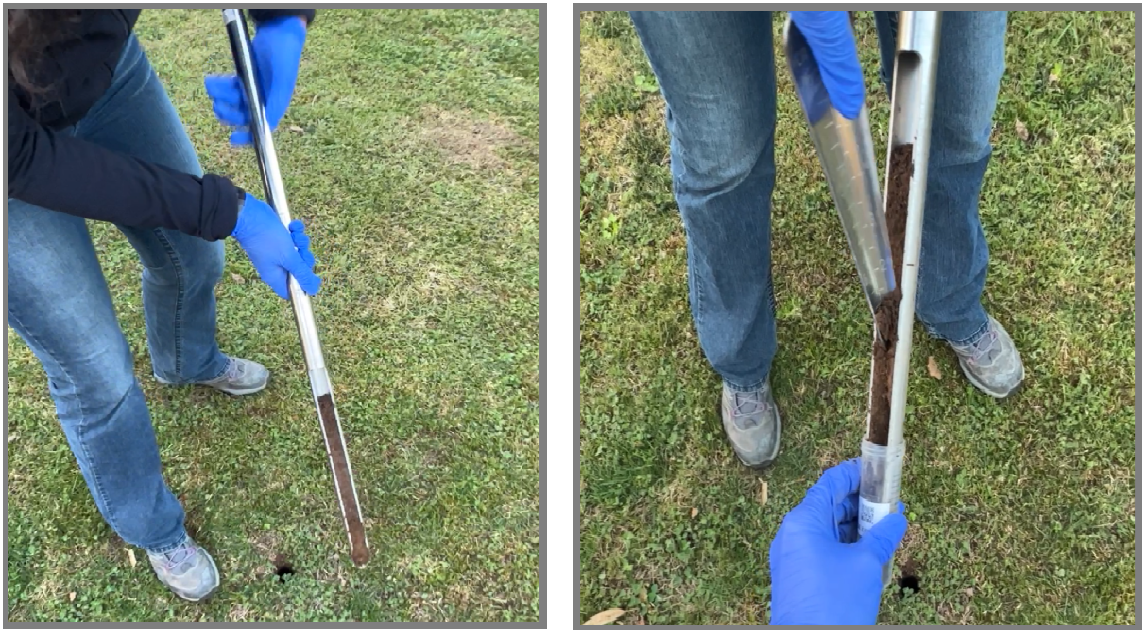
Soil samples are generally collected as “soil cores” and these cores are pooled in the field into sterile zip-lock bags, or stored individually to be pooled later in the lab. The samples are then transported to the lab in cool conditions (e.g. in a cooler box with ice packs or dry ice).
Note
The Biodiversity Genomics Europe followed individual core storage within sterile Falcon tubes, placing each sample immediately on dry ice to halt microbial activity. The soil sampling SOP (Najera-Cortazar et al. 2024) can be found in sampling soil and in the BGE case studies section
General considerations
Sample size. Individual soil samples should be sufficiently large to ensure there is enough material for DNA extraction, required physicochemical analysis, and for storage/backup.
Spatial scale. In order to maintain statistical independence of samples at a site, samples should be positioned beyond the spatial autocorrelation range, usually 5-10 meters in soil fungi.
Sample labels Preparing a robust labelling system is essential to avoid sample misidentification and loss of metadata. It will improve the speed of processing samples on-site and in the lab. Labels can be generated prior fieldwork, using individual QR codes (see PlutoF section), waterproof paper and ink, or printed on regular paper and laminated.
Pooling samples. There should be several soil cores sampled per site (typically ranging from 5 to 25, depending on the methodology). These soil cores are or subsamples taken in the same site, and the amount of subsamples can significantly impact the representation of biodiversity in heterogeneous environments; using fewer subsamples may lead to an underestimated diversity. The best approach for pooling these subsamples is doining the pooling on-site, but this can change according to the aim of the sampling collection. For bacterial communities, the best approach would be to immediately store each subsample in cold condition to prevent overgrowth.
The pooling effect is also influenced by the diversity of habitats, such as pH levels, organic material, salinity, and types of plant species existing. Given the greater overall richness, pooled samples also require deeper sequencing to detect rare taxa. However, pooling is unsuited for co-occurrence analyses assessing biotic interactions.
Sampling
Sample during dry weather to avoid contamination by water from rain and wet gloves.
Wear esterile disposable gloves during sampling to avoid contaminating samples with skin or foreign microbiota.
Sterilize sampling tools to avoid cross-contamination between independent samples. Sterilization should be done with with oxidizing agents (e.g., 10% bleach) or flame, and wiping with EtOH. Sterilization should not be done only with EtOH as the latter do not denature DNA.
Place samples into sterile zip-lock bags or screw-cap vessels.
To remove site or sampling material contaminants a posteriori, include field controls (e.g., empty tubes left opened at the site or extraction of sample storage buffer).
After sampling
Maintain the samples at cool temperature during transport to limit biological activity within samples.
When possible, the best option is to either extract DNA right after sampling or to rapidly freeze the collected materials in liquid nitrogen and maintain them at -80°C. Pooled subsamples must be well mixed before freezing, as it is later difficult to homogenize frozen material. When freezing, it is important to avoid multple melt-thaw cycles, which may lead to significant changes in the detected communities.
Often, freezing is not possible. Drying of soil samples is a viable alternative (Smenderovac et al 2024). Drying with silica gel is a viable option for few grams of soil. Dried samples can be kept for long time (decades) if kept air-tight in the dark and at constant temperature (room temperature).
Prior to DNA extraction, it is important to homogenize the soil sample.
It is important to double check that labels are visible and legible, recorded in a field book (paper or digitally), and properly backed up.
References
Najera-Cortazar, L. A., Beja-Pereira, A., & Beja, P. (2024). Biodiversity Genomics Europe | Ecological Restoration - Soil sampling. WorkflowHub. https://doi.org/10.48546/workflowhub.sop.19.1
Tedersoo, L., Bahram, M., Polme, S., Koljalg, U., Yorou, N. S., Wijesundera, R., Ruiz, L. V., Vasco-Palacios, A. M., Thu, P. Q., Suija, A., Smith, M. E., Sharp, C., Saluveer, E., Saitta, A., Rosas, M., Riit, T., Ratkowsky, D., Pritsch, K., Poldmaa, K., … Abarenkov, K. (2022). Best practices in metabarcoding of fungi: From experimental design to results. Molecular Ecology, 31(10), 2769-2795. https://doi.org/10.1111/mec.16460