
Malaise trap
Used for trapping arhtropods (mostly flying insects).
The following guidelines provide instructions for Malaise trap sampling used in the Biodiversity Genomics Europe project to identfy species in the bulk arthropod samples. Herein, Townes style Malaise traps with a white roof are used.
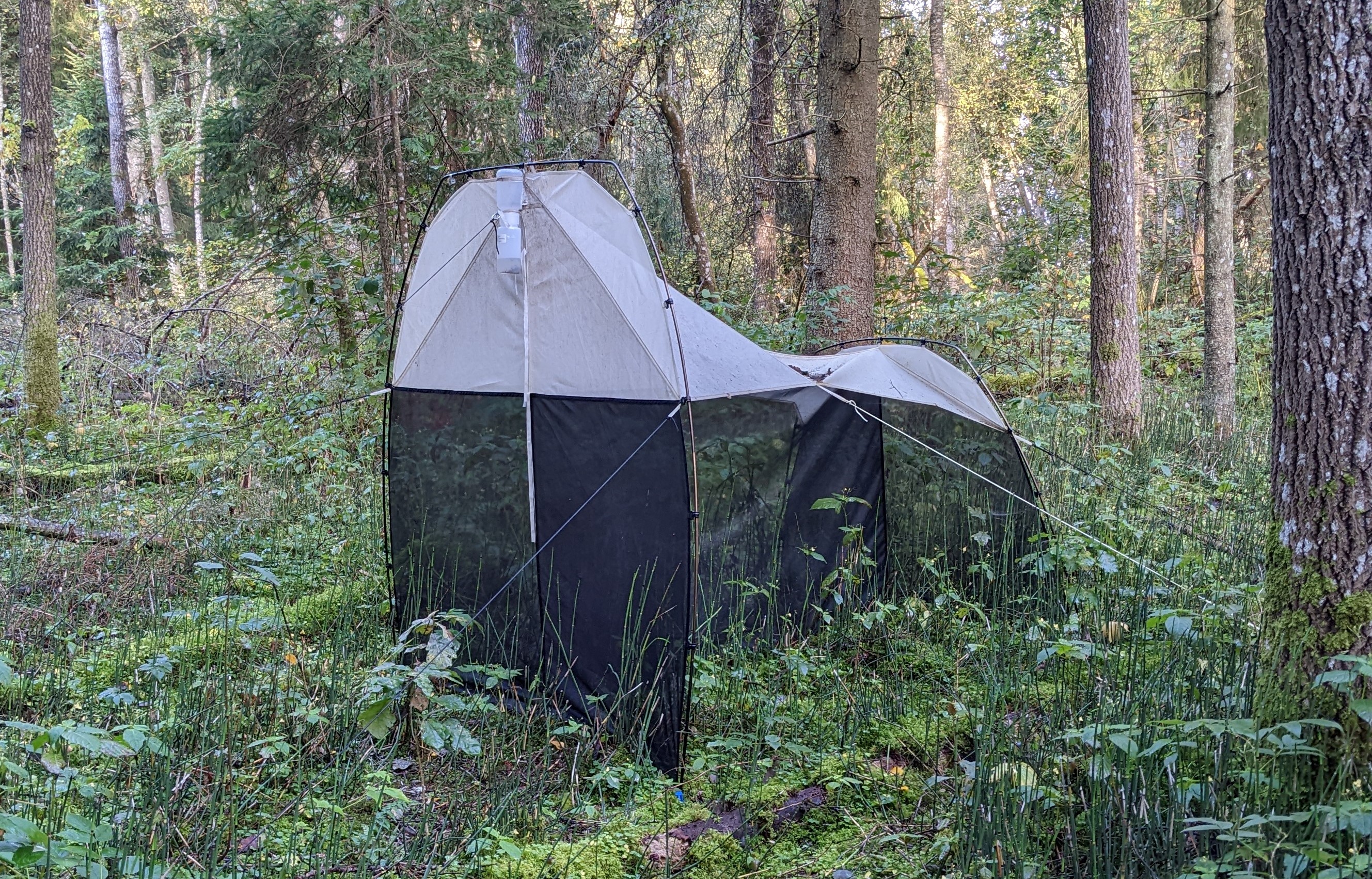 Townes style Malaise trap with a white roof. Click on the image to open Malaise trap set up instructions video link [at youtube].
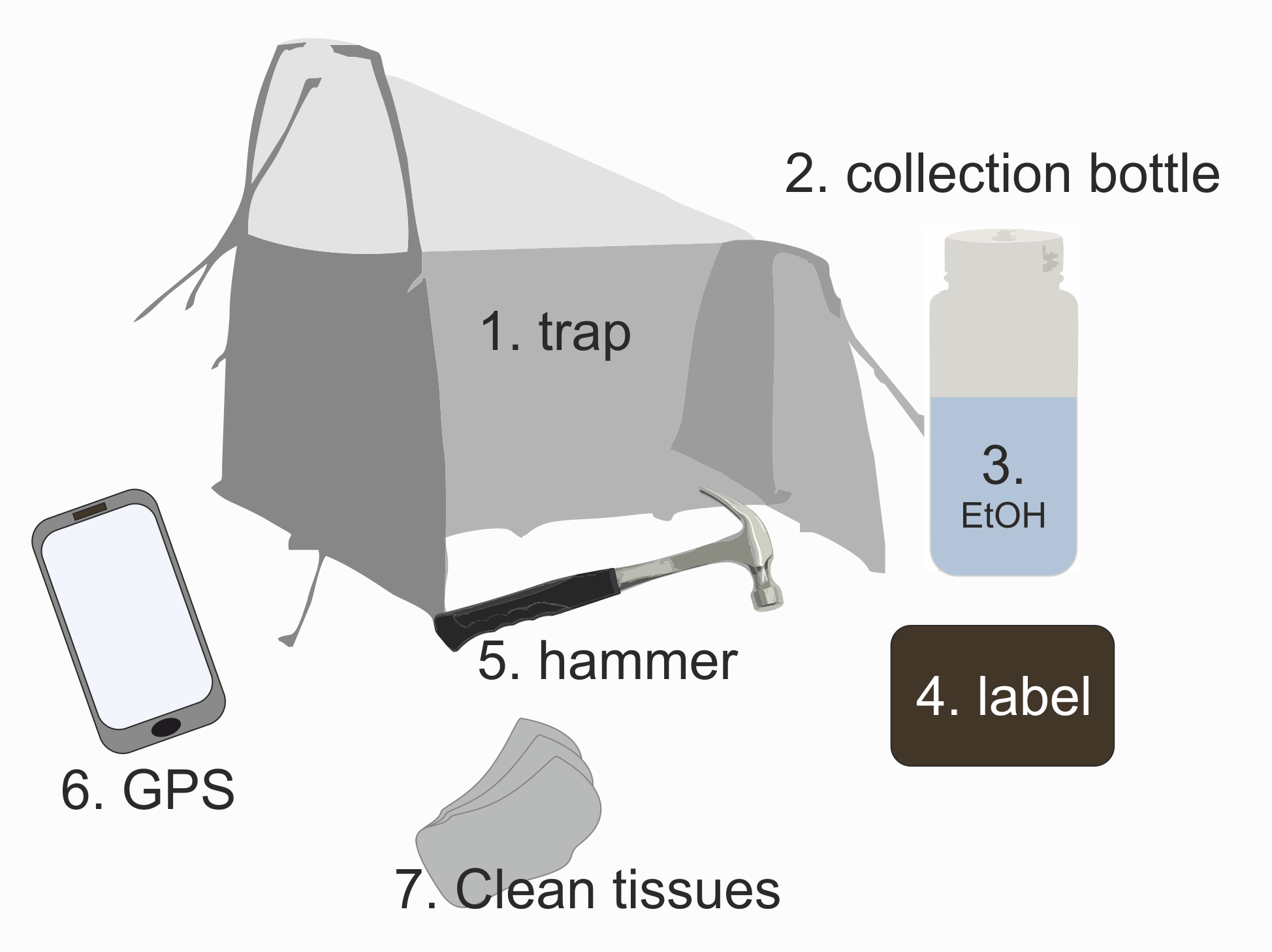
List of equipment
Malaise trap (including extra set-up cords and pegs)
500 mL sterile collection bottle (‘Wide-Mouth LDPE Bottles with Closure’)
96% or stronger ethanol (EtOH), not denatured (to ensure good DNA preservation)
Labels for the samples (collection bottles), and the means to fix the lable (e.g. transparent tape)
Hammer (may be needed for fixing the trap with pegs)
Device with a global positioning system (GPS)
Optional: tissues (paper-towels) to wipe the trap head from dead arthropods when chaning the collection bottle (when temporal patterns are of interest).
General considerations
Trap characteristics. There are different models of Malaise traps available, but the most commonly used is the Townes style Malaise trap. It is needed to standardize the trap type used across sites within a project, as different trap types may have different collection efficiencies for different arthropod groups
Remove grid from trap. Some models include plastic grids/filters that prevent larger arthropods to fall in the trap. In order to sample all arthropod groups, the grid should be removed.
Sample labels Preparing a robust labelling system is essential to avoid sample misidentification and loss of metadata. It will improve the speed of processing samples on-site and in the lab. Labels can be generated prior fieldwork, using individual QR codes (See Register samples in PlutoF), waterproof paper and ink, or printed on regular paper and laminated.
First time set-up
Select a suitable spot (see below, ‘Placement of the Malaise trap’).
Set up the trap (see video below; instructions provided also in the Malaise trapping SOPs (Najera-Cortazar et al., 2024))
Attach the collecion bottle to the trap.
Make sure to store the bottle lid in a way it will not be contaminated (store in e.g. clean zip-lock bag).
Let the trap do its job.
Placement of the Malaise trap
Placement of the Malaise trap is important; this affects the the collection efficiency. Herein quoting Gressitt and Gressitt (1962): it should be set up where insect flight tends to be concentrated by local circumstances of topography, density or lack of vegetation, relation to wind, water and such aspects. Suitable places are across a small stream or gully, across a wide trail in the forest, at a low pass on a ridge, be tween two types of vegetation, in a clearing, plantation or savanna woodland at right angles to edge of adjoining dense rain forest, or at an opening to a clearing. The collecting head should always be in the sun (van Achterberg, 2009).
For own consideration: see Uhler et al., 2022, A comparison of different Malaise trap types for the variability in different groups of arthropods trapping efficiency between different types of Malaise traps.
Before sampling
Fill the collection bottle with 96% ethanol, ~300 ml (but may be less depending on the expected biomass of arthropods, collection time and evaporation potential); and fix the label to collection bottle (if applicable).
Collecting samples
Collect the collection bottle
Add more ethanol (if needed) to ensure all individuals are submerged, and attach the lid
If placing a new collection bottle, then use a clean paper tissue to clean the trap head to remove dead arthropods
The specimens in ethanol may be preserved at room temperature, avoiding light exposure (but -20˚ C is advisable for long term storage).
References
Gressitt, J. L., & Gressitt, M. K. (1962). An improved Malaise trap. Pacific insects, 4(1), 87-90.
Najera-Cortazar, L., Ferreira, S., Mata, V., & Beja, P. (2024). Biodiversity Genomics Europe | High Mountain Systems - Arthropod sampling with Malaise traps. WorkflowHub. https://doi.org/10.48546/WORKFLOWHUB.SOP.17.3
van Achterberg, K. (2009). Can Townes type Malaise traps be improved? Some recent developments. Entomologische berichten, 69(4), 129-135.
Uhler, J., Haase, P., Hoffmann, L., Hothorn, T., Schmidl, J., Stoll, S., … & Müller, J. (2022). A comparison of different Malaise trap types. Insect Conservation and Diversity, 15(6), 666-672.